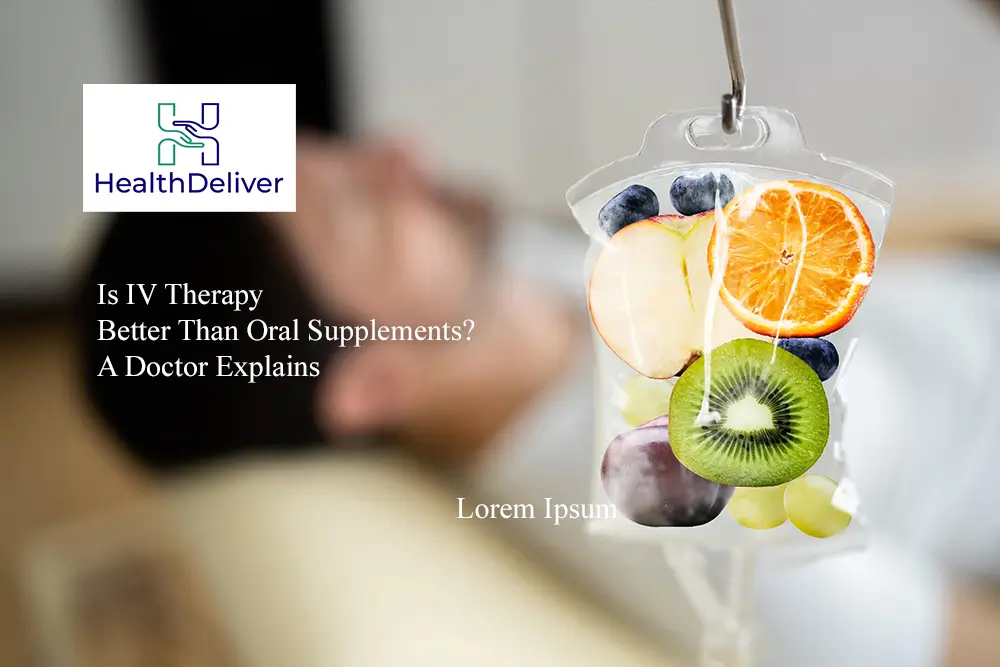
IV Therapy Vs Oral Vitamin Supplements- You’ll get nutrients into your bloodstream faster with IV therapy, and some vitamins (like high‑dose vitamin C, B12, thiamine) and minerals can reach higher, predictable levels this way. But IV isn’t automatically better for most people — it’s costlier, invasive, and carries infection and electrolyte risks.
Make An Appointment Here
Oral supplements work well for routine needs and mild deficiencies and are safer and cheaper. If you want a quick correction or have malabsorption, IV can be appropriate — learn when and why.
Key Takeaways IV Therapy and Oral Supplements
- IV therapy delivers nutrients directly into blood, achieving faster and higher plasma levels than oral supplements.
- Oral supplements are usually effective, safer, and far less expensive for routine deficiencies.
- IV is appropriate when rapid repletion or gut malabsorption prevents adequate oral absorption.
- IV carries higher risks: infections, allergic reactions, and electrolyte imbalances requiring clinical monitoring.
- Choose based on clinical assessment, lab results, cost, and clear goals agreed with a qualified clinician.
How Nutrient Absorption Works: Oral Vs IV Pathways
Although both oral supplements and IV therapy aim to deliver vitamins and minerals to your body, they follow very different absorption routes: oral nutrients must survive digestion, cross the intestinal lining, and pass through the liver before reaching systemic circulation, while IV nutrients bypass the gut and go directly into the bloodstream, producing faster and often higher serum concentrations.
You’ll find oral absorption mechanisms involve dissolution, transport across enterocytes, and first-pass hepatic metabolism, which can limit bioavailability and slow onset. IV delivery eliminates those barriers, raising delivery efficiency and allowing controlled plasma levels.
Clinical studies show IV routes give predictable concentrations when rapid correction is needed, while oral forms remain appropriate for maintenance and lower-risk supplementation due to convenience and lower cost.
Which Nutrients Benefit Most From IV Delivery
Which nutrients actually gain the most from IV delivery?
You’ll see the clearest advantages with water-soluble vitamins and minerals where oral absorption is limited or slow. Vitamin C, B-complex vitamins (especially B12 and thiamine), and certain minerals like magnesium and calcium reach higher plasma levels faster via IV, improving delivery efficiency for short-term correction.
Fat-soluble vitamins (A, D, E, K) don’t routinely need IV unless malabsorption exists, since they require carrier mechanisms and tissue uptake. Amino acids and electrolytes also show predictable plasma increases with IV dosing.
Evidence supports IV when achieving rapid, controlled blood concentrations matters more than steady oral intake, but benefits depend on dosing, monitoring, and clear clinical goals rather than popularity alone.
Medical Situations That Warrant IV Nutrition
When you need rapid, reliable nutrient delivery that the gut can’t provide, IV nutrition becomes medically appropriate.
You’d consider it in acute illness when absorption is impaired — severe gastroenteritis, pancreatitis, or critical care scenarios where enteral feeding isn’t feasible.
If tests show a significant nutrient deficiency that oral therapy can’t correct quickly or effectively, IV replacement gets prioritized.
You’ll also use it for dehydration management when oral rehydration fails or when vomiting prevents intake.
After major surgery, IV nutrition supports post surgery recovery by maintaining fluid, electrolytes, and calories while the gut heals.
After major surgery, IV nutrition sustains fluids, electrolytes, and calories to support recovery while the gut heals
Decisions should follow clinical guidelines and objective labs; IV nutrition complements, not replaces, efforts to restore normal oral intake as soon as it’s safe.
Risks and Side Effects of IV Therapy
When you consider IV therapy, be aware it carries risks like catheter-related infection or contaminated fluids that can cause serious illness.
You can also develop electrolyte imbalances if doses aren’t customized or monitored, and some people have allergic or infusion reactions ranging from mild hives to anaphylaxis.
Discuss these possibilities with your clinician so monitoring and prevention strategies are in place.
Infection and Contamination
Because IVs bypass your skin’s primary defenses, they create a direct route for bacteria and other pathogens to enter the bloodstream, raising risks of local site infections, bloodstream infections (including sepsis), and contamination-related complications.
Strict aseptic technique, proper catheter care, and sterile solutions are essential to minimize these hazards. You should expect trained providers to follow infection control bundles—hand hygiene, sterile gloves, chlorhexidine skin prep, and closed-system lines—to reduce catheter-associated bloodstream infections.
Watch for redness, swelling, fever, chills, or drainage and report them immediately. Facilities should use contamination prevention measures like single-use vials, proper storage, and routine line assessment.
If an infection is suspected, clinicians will remove the line, culture the site and blood, and start targeted antibiotics to prevent escalation and protect patient safety.
Electrolyte Imbalance Risks
In addition to infection risks, IV therapy can quickly change your blood electrolyte levels because it delivers fluids and salts directly into circulation; improper composition, rate, or volume can cause hyponatremia, hypernatremia, hypokalemia, hyperkalemia, hypocalcemia, or metabolic acidosis/alkalosis.
You’ll notice symptoms fast if levels swing: weakness, arrhythmia, confusion, or seizures. Monitoring labs and tailoring fluids to your hydration status prevents most problems. Be wary of unregulated “hydration” mixes that ignore individual electrolyte deficiency.
- Check baseline electrolytes before treatment.
- Match fluid composition to deficits and hydration status.
- Adjust infusion rate for cardiac or renal disease.
- Reassess labs during and after prolonged infusions.
IV therapy helps when indicated, but it demands medical oversight to avoid harm.
Allergic and Infusion Reactions
Although rare with proper screening, allergic and infusion reactions from IV therapy can be sudden and serious, so you should know the signs and how they’re managed.
You might experience itching, hives, wheezing, shortness of breath, hypotension, or chest tightness; severe cases can progress to anaphylaxis. Infusion reactions can also present with fever, chills, nausea, or flushing without classic allergy features.
Providers monitor you during and after infusion, stop the infusion at first sign of a reaction, and give antihistamines, corticosteroids, bronchodilators, or epinephrine as indicated.
They’ll assess causality, document the event, and adjust future therapy—changing formulation or avoiding IV administration. Proper history-taking, test dosing when appropriate, and trained staff reduce risk and improve outcomes.
Evidence for IV Therapy in Performance and Wellness
When you evaluate IV therapy for performance or general wellness, focus on high-quality clinical trials and systematic reviews rather than anecdotes or marketing claims. You should expect limited, mixed evidence for routine use: some small randomized trials show transient improvements in hydration, recovery, or fatigue, but larger, well-controlled studies are sparse.
Look for outcomes that matter—objective performance measures, validated wellness scores, and safety data.
- Check randomized controlled trials for measurable performance enhancement.
- Prefer systematic reviews or meta-analyses over case series.
- Verify clinically meaningful effect sizes, not just statistical significance.
- Confirm consistent safety reporting across studies.
Use evidence to weigh potential wellness benefits against unclear long-term advantages.

Cost, Convenience, and Practical Considerations
Because IV therapy often requires clinical staff, supplies, and facility overhead, you’ll usually pay far more than for equivalent oral supplements, and that cost differential matters when assessing modest or uncertain benefits.
Do a straightforward cost analysis: compare per-dose prices, frequency, and indirect costs like travel and time off work.
Do a straightforward cost analysis: compare per-dose prices, dosing frequency, and indirect costs like travel and time off work
Consider convenience factors: oral pills are portable, self-administered, and fit daily routines, while IV sessions need appointments and recovery time.
Factor safety monitoring and potential complications that can add costs. Insurance rarely covers elective IV nutrient infusions, so out-of-pocket spending mounts.
If you’re evaluating marginal benefits, ask whether the incremental clinical advantage justifies the extra expense and logistical burden.
Use evidence and personal priorities to guide your choice.
When Oral Supplements Are Safer and More Effective
If you’re choosing between routes, pick oral supplements for routine needs and mild deficiencies—trials show they correct common shortfalls (like vitamin D or iron in many cases) as effectively as IVs for most people, carry far fewer risks, and cost a fraction as much.
You’ll favor oral supplement safety when you don’t need rapid repletion or intravenous access. Studies support equivalent nutrient absorption effectiveness for many vitamins and minerals when doses are appropriate and adherence is good.
Consider situations where oral is preferable:
- You have a mild deficiency diagnosed by labs.
- You can take and tolerate daily dosing with good adherence.
- You lack symptoms of malabsorption or severe deficiency.
- You want lower risk of infection, phlebitis, or allergic reaction.
Discuss monitoring and dose adjustments with your clinician.
How to Talk With Your Clinician About IV Options
Start by telling your clinician your goals and what you expect from IV therapy versus oral supplements so you can align treatment to measurable outcomes.
Share your full medical history, current medications, and any allergies so they can assess safety and interactions.
Ask about specific risks, evidence for benefit, and effective alternatives if IV isn’t the best option.
Goals and Expectations
Wondering what IV therapy can realistically do for you? Use goal setting and expectation management when you talk with your clinician. Be specific about symptoms, timelines, and measurable outcomes so choices match evidence and need.
- State your main goal (e.g., rehydration, quicker recovery, targeted nutrient correction).
- Ask what outcomes are supported by research and which are anecdotal.
- Clarify how soon you might notice changes and how long benefits last.
- Confirm follow-up plans, objective measures, and when to stop or switch strategies.
This keeps the conversation clinical and practical. You’ll avoid oversold promises, align treatment with realistic benefits, and guarantee decisions rest on documented indications rather than anecdotes or marketing.
Medical History Review
Because IV therapy bypasses the gut and delivers nutrients or fluids directly into your bloodstream, your clinician needs a focused medical history to assess safety and effectiveness.
You’ll be asked about chronic conditions, allergies, medication list, and any bleeding or clotting disorders. Share accurate patient history, including renal, hepatic, cardiac issues, and immune status, since they change dosing and monitoring.
Discuss previous treatments like IV antibiotics, chemo, or prior infusions and any reactions you had. Mention supplement use and recent lab results so the clinician can compare baseline levels to expected IV effects.
This review informs appropriate fluids, electrolytes, and micronutrient choices and helps plan monitoring, follow-up labs, and adjustments customized to your medical situation.
Risks and Alternatives
After reviewing your medical history and labs, you and your clinician should talk openly about the potential risks of IV therapy and the alternative options that might meet your goals.
You’ll discuss a risks assessment that covers infection, air embolism, fluid overload, electrolyte imbalance, and allergic reactions. Ask for evidence: complication rates, contraindications, and monitoring plans.
- Expected benefits vs. documented risks — ask for data.
- Alternatives — oral supplements, dietary changes, timed injections, monitored IV in clinic.
- Practical considerations — cost, access, frequency, and recovery time.
- Follow-up — when to seek help and how outcomes will be measured.
Use this checklist to guide shared decision-making and choose the safest, evidence-based plan.
Red Flags and Questions to Ask Before Getting an IV
How will you know if an IV treatment is safe and appropriate for you? Start by asking about the patient assessment process: will a clinician review your medical history, current meds, allergies, and labs?
Confirm they’ll explain IV therapy benefits, limitations, and evidence for your condition. Red flags include pressure to buy add-ons, promises of cures, treatments without exam or labs, nonmedical staff administering IVs, or unclear ingredient lists.
Ask who performs the infusion, their credentials, sterility protocols, emergency procedures, and how they monitor for reactions.
Request written consent and expected side effects. If they can’t or won’t answer clearly, walk away. A careful, evidence-based approach protects you and guarantees any benefit outweighs risk.

Conclusion
IV therapy can be useful in specific medical situations — like severe dehydration or malabsorption — but for most people oral supplements are safer, cheaper, and effective. One study found routine IV “vitamin drips” deliver nutrients at a fraction of hospital-level necessity: only about 5% of U.S. adults receive clinically indicated parenteral nutrition annually. Talk with your clinician about goals, risks, and costs so you choose evidence-based, individualized care rather than marketing hype.
About HealthDeliver Clinic Bangkok
HealthDeliver Clinic is a leading integrated healthcare provider in Bangkok offering personalized, evidence-based care for residents, tourists, and expats. Our services include IV therapy, oral supplement guidance, and advanced gut health testing using GI-MAP, GI-MAP+, and DUTCH OAT assessments. With licensed clinicians, transparent protocols, and multiple locations in Asoke, Sathorn, and Nana, we help you feel your best with safe, tailored treatment options. Whether you’re managing fatigue, nutrient deficiency, or digestive issues, HealthDeliver combines modern diagnostics with patient-first care.
Make An Appointment Here
FAQs About IV Theray Vs Oral Vitamin Supplements
What are the benefits of IV therapy compared to oral supplements?
IV therapy provides a direct method of delivering nutrients and vitamins into the bloodstream, bypassing the digestive system. This ensures higher bioavailability and faster absorption compared to traditional oral supplements like vitamin pills and tablets, making it more effective for immediate wellness needs.
How does IV vitamin therapy improve nutrient absorption?
IV vitamin therapy skips the digestive process, allowing essential vitamins and nutrients to be delivered directly to the body. This method enhances the body’s ability to absorb nutrients, which can be particularly beneficial for individuals with digestive issues or those seeking to maximize their wellness routine.
In what situations should I consider IV therapy over oral supplements?
IV therapy is particularly beneficial for individuals who require immediate hydration, faster nutrient absorption, or have digestive tract issues that hinder the efficacy of oral supplementation. It offers customized IV infusions that can target specific health concerns, allowing you to feel your best quickly.
What are the key differences between IV therapy and oral vitamin absorption?
The key differences revolve around how nutrients are delivered. IV therapy delivers vitamins and nutrients directly into the bloodstream, ensuring higher absorption rates, while oral supplements must pass through the digestive system, which can reduce their effectiveness due to digestive issues or poor absorption.
Can IV therapy provide immune support better than oral supplements?
Yes, IV therapy can offer superior immune support by delivering a concentrated dose of vitamins and minerals directly into the bloodstream. This can be particularly useful during times of stress or illness when the body needs a boost to feel its best.
What types of nutrients are typically delivered through IV infusions?
IV infusions commonly include a variety of essential vitamins, minerals, and hydration fluids. Common nutrients delivered through intravenous supplements include vitamin C, B vitamins, magnesium, and amino acids, all aimed at enhancing vitality and overall wellness.
Are there any downsides to IV therapy compared to oral supplementation?
While IV therapy offers numerous benefits, it can be more costly and require a visit to a clinic or healthcare professional for administration. Additionally, some individuals may prefer the convenience of taking oral supplements, which can easily fit into a daily maintenance routine.
How can I feel my best with IV therapy?
To feel your best with IV therapy, consider consulting a healthcare provider to tailor an intravenous supplement therapy plan that meets your specific health needs. Personalized IV infusions can help ensure you receive the right balance of nutrients to support your wellness goals.